
Elderly Care
Overseas Elderly Care Support: Establishment of a Care Training Room in Vietnam
Table of Contents
- Introduction
- The Reality of Aging Population in Vietnam
- Current State of Elderly Care Services in Vietnam
① Residential Facilities
② In-Home Care - Our Support Case: Establishing a “Japanese-Style Simulated Care Room” at National Bach Mai Hospital
- Conclusion
Introduction
MEDIVA has contributed to the development of healthcare overseas, by leveraging our long-standing expertise in medical, and elderly care consulting in Japan. In this article, we introduce a case study of our elderly care support initiative in Vietnam, exploring the current landscape and future possibilities in the country.
The Reality of Aging Population in Vietnam
Rapid population aging is now a common challenge across Asia. Driven by declining birth rates and increasing life expectancy, Vietnam is aging at one of the fastest rates in the region. According to UN estimates, the population aged 65 and older accounted for approximately 8.2% of Vietnam’s total population in 2022 and passed 9.0% in 2024. It is projected to reach approximately 14% by 2036, officially marking its transition into an “aged society.” The aging trend is expected to continue steadily thereafter.
Projected Trends in the Aging Rate
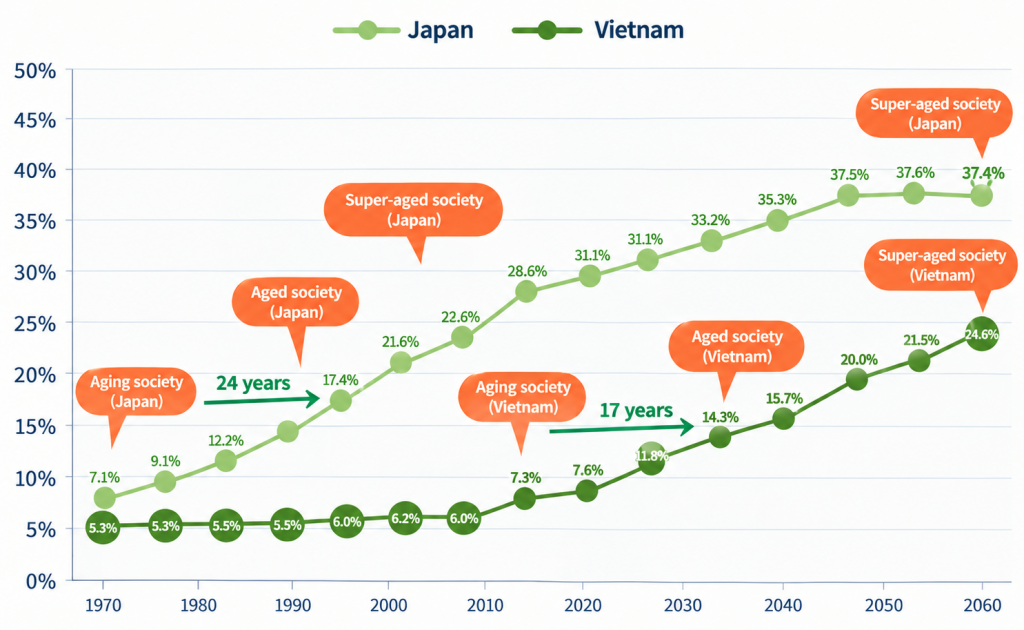
Source: Compiled by MEDIVA based on UN World Population Prospects 2024
While aging is increasingly recognized as a social issue in Vietnam, the country remains in a developmental stage regarding institutional design, workforce training, and quality of hands-on care. Establishing a solid foundation for elderly care while systems and services are still catching up is a critical national challenge.
Current State of Elderly Care Services in Vietnam
① Residential Facilities
In recent years, local developers and major private hospitals in Vietnam have begun to construct large-scale elderly care facilities targeted at the affluent population, with some Japanese-capital facilities entering the market as well.
However, site visits to numerous facilities reveal that despite luxurious exteriors and modern amenities, many lack the practical design required for elderly care. Inadequate barrier-free architecture—such as structures with frequent steps or rooms not designed for wheelchair maneuverability—highlights a stark difference in design philosophy compared to Japanese care homes. Furthermore, specialized care for the elderly with severe mobility limitations, such as difficulty walking independently, is often overlooked, creating a gap between on-site services and the actual needs of residents.
Additionally, family-centered care remains the norm in Vietnam; the concept of moving parents or oneself into a facility when care is needed has not taken its root. Without a public long-term care insurance system, costs are fully out-of-pocket, restricting residency primary to the wealthy. Consequently, even large facilities are currently experiencing high vacancy rates.
② In-Home Care
For families facing difficulties providing care themselves, as well as wealthy households, domestic helpers known as “Hộ lý” have traditionally handled both housework and elderly care.
However, Hộ lý do not have specialized knowledge of medical or elderly care, and their support is essentially an extension of home care. Local feedback indicates that seniors are often left largely bedridden, lacking an approach that aims to support independence and preserve dignity, as practiced in Japan.
In response, home-based services—such as day service, rehabilitation, visiting nursing, and home care—are gradually emerging in major urban centers. Nevertheless, like residential facilities, these services require 100% out-of-pocket payment, meaning widespread adoption will take time.
Price Range of Elderly Care Services (Reference)
| Service Type | Approximate Monthly Cost | |
| Residential Facility | Urban (Luxury) | Multi-bed room: ¥80,000 – ¥200,000 |
| Private room: ¥140,000 – ¥300,000 | ||
| VIP: ¥400,000 | ||
| Suburban (General) | Multi-bed room: ¥40,000 – ¥80,000 | |
| Private room: ¥80,000 – ¥130,000 | ||
| In-Home Service | Day Service | ¥3,000 – ¥5,000 / day |
| Home Care: Provided by Holy | ¥1,000 – ¥2,000 / day | |
Source: Compiled by MEDIVA based on select local case studies.
Given these circumstances, expectations are rising in Vietnam for multi-faceted support from Japan as an advanced aging nation—ranging from policy design and workforce development systems to practical care technique instruction. Crucially, “Certified Care worker” does not yet exist as an official job classification in Vietnam; elderly care in hospitals and facilities is currently handled by nurses or Hộ lý.
As population aging progresses, the need to institutionalize the professional status of care workers is becoming widely recognized, leading to growing expectations for support from Japan to establish this framework.
Below, we introduce a specific case study of our support.
Our Support Case: Establishing a “Japanese-Style Simulated Care Room” at National Bach Mai Hospital
National Bach Mai Hospital in Hanoi is Vietnam’s largest general hospital, featuring 1,400 beds. On its campus, Bach Mai Medical College trains future nurses and rehabilitation professionals.
In 2024, MEDIVA supported the establishment of a Japanese-Style Simulated Care Room within the college to promote Japanese-style elderly care and train local talent. Equipped with modern Japanese care technology, the facility features care beds, monitoring sensors, walkers, wheelchairs, canes, portable toilets, shower chairs, and educational materials for experiencing aging.
Alongside the setup, we conducted a two-week training program for university faculty, focusing on equipment utilization and Japanese elderly care techniques. Participants showed high interest in body mechanics, transfer devices, and monitoring equipment, actively participating in practical sessions and asking detailed questions.
The training highlighted noticeable differences in foundational techniques—such as wheelchair operation and walking assistance—revealing gaps between Japanese standards and current local practices. Today, trained faculty members instruct their own students on operating the equipment.
Moving forward, the training room will serve both university students and internal/external training programs. Please contact MEDIVA if you wish to arrange a visit.
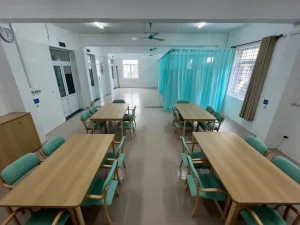
Tables and chairs commonly seen in Japanese care homes—featuring rounded corners, soft materials, stackable chairs, and height-adjustable tables—received high praise for their thoughtful design.
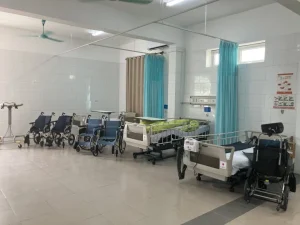
Using actual devices, sessions guided participants to analyze bad examples and evaluate the necessity of adjusting equipment height based on each individual’s physical condition and stature.
Conclusion
With every visit to Vietnam, the growing focus on aging population is palpable. Although, the certified role of “Care worker” is not yet established, shifts toward its future institutionalization are beginning to take shape, leading to potential growth in the elderly care market.
In reality, the concept of “care” has yet to fully take root in the society. Going forward, it will be essential to share the know-how and practical knowledge of independence support developed in Japan, while co-creating a care model tailored to Vietnam’s social background and culture.
MEDIVA remains committed to supporting elderly care development across Asia.
Please feel free to reach out to us with any inquiries.
