
Healthcare Systems Policies
Aging ASEAN Countries: Leveraging Japanese Expertise to Support the Future of Long-Term Care
Table of Contents
- Introduction
- Current State of Aging in ASEAN Countries
- Insights and Realities Shared by Our Overseas Team
① Current Situation in Thailand
② Current Situation of Long-Term Care Facilities in Vietnam - Future Outlook: Opportunities for Japanese Business Operators
1. Introduction
In recent years, aging has been progressing rapidly in ASEAN countries. Once highlighted as a “growth market with a young population,” the region is now experiencing a rising proportion of elderly citizens due to declining birthrates accompanying economic development and extended life expectancies.
Since last year, inquiries regarding long-term care have grown significantly, reflecting a clear rise in attention to this issue. This article examines the current state of aging in ASEAN countries, local policy responses, and future outlooks, backed by key learnings from our field research.
2. Current State of Aging in ASEAN Countries
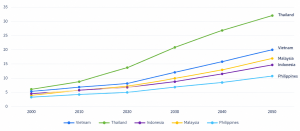
The graph below shows the trends in aging rates (including projections) for ASEAN countries (Thailand, Malaysia, the Philippines, Vietnam, and Indonesia) from 2000 to 2050.
Created by Mediva based on METI Country Report data
Looking at the trends, rapid aging is particularly evident in Thailand and Vietnam.
In Thailand, the aging rate is projected to rise from 6.1% in 2000 to 31.6% in 2050, reaching levels comparable to developed nations.
Vietnam is also expected to reach 20.4% by 2050, marking a distinct transition into an aged society.
On the other hand, Indonesia, Malaysia, and the Philippines show relatively gradual increases. In particular, the Philippines is expected to remain at 10.8% even as of 2050, keeping it a country with a relatively young demographic within ASEAN.
As shown, significant differences exist in the pace of aging across ASEAN countries. These disparities are thought to stem from variations in the pace of economic development, improvements in healthcare, and shifts in birthrates.
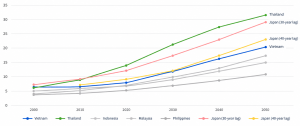
Furthermore, the graph below plots Japan’s aging trends alongside these nations, shifted by 30 and 40 years.
Created by Mediva based on METI Country Report data
The progression of aging in Thailand and Vietnam follows a trajectory remarkably similar to Japan’s past. Thailand is aging roughly 30 years behind Japan, rising from 6.1% in 2000 to a projected 31.6% in 2050.
This trajectory overlaps with the pace of aging Japan experienced between 1970 and 2020. Based on this, Thailand’s current situation is considered close to that of Japan in the mid-1990s—a period when supporting the elderly through family care alone became difficult, long-term care grew into a social issue, and discussions around introducing a formal long-term care insurance system began in earnest.
Similarly, Vietnam’s aging process is lagging Japan’s by approximately 40 years, expected to increase from 6.4% in 2010 to 20.4% in 2050. This shift resembles Japan’s changes between 1970 and 2010.
Vietnam’s current situation is close to Japan in the mid-1980s, when the aging rate surpassed 10% and prompted the government and society to begin taking serious action on aging measures.
Of course, given differences in the social environment—such as technological advancements—we cannot simply assume a carbon copy of Japan’s past. However, the aging challenges Japan faced (establishing medical care, nursing care, and institutional systems) are highly likely to become critical issues in ASEAN countries as well. Japan’s experience can serve as a valuable reference both policy-wise and industrially.
3. Insights and Realities Shared by Our Overseas Team
① Current Situation in Thailand
Recently in Bangkok, we had the opportunity to exchange views on long-term care in Thailand with a major corporation. In Thailand, alongside long-term care issues that are beginning to surface, government-led development of care facilities is underway in anticipation of rapid future aging.
Driven by government requests, the company was seriously considering entering the care facility sector and expressed strong interest in collaborating while learning from Japan’s experience.
Traditionally in Thailand, elderly individuals lived in rural areas and were cared for by family members within large extended households. However, with nuclear families becoming more prevalent in urban areas, the necessity for long-term care facilities is gradually being recognized.
Thai companies generally demonstrate a serious commitment to the care business, and we see strong potential for building business partnerships with them.
On the other hand, awareness of elderly people requiring long-term care remains relatively low within Thailand, and a clear, shared concept of care services is not yet widespread. When designing facility concepts and constructing service offerings, deepening the foundational understanding of long-term care will likely be the critical first step.
② Current Situation of Long-Term Care Facilities in Vietnam
In Vietnam, we inspected several long-term care facilities, but by Japanese standards, the environment could not yet be called sufficient. Facility sanitation leaves room for improvement, and in terms of hardware, there were cases where elevators were not designed for wheelchair accessibility, creating major mobility constraints. Regarding the quality of care, it remained significantly lower compared to Japanese standards, making it difficult to say that residents were receiving adequate care.
Despite this, these facilities were attracting a steady number of residents, pointing to strong demand for care services. The facility usage fees were by no means inexpensive, suggesting a substantial financial burden for many households given Vietnam’s economic conditions. The high demand for facilities under these circumstances is likely driven by the growth of nuclear families in urban areas and the difficulty of providing care at home.
While there is great potential to leverage Japan’s long-term care expertise, simply importing the Japanese model will not suffice. It will be essential to develop sustainable care service models tailored to local economic realities and social contexts.
4. Future Outlook: Opportunities for Japanese Business Operators
In ASEAN countries such as Thailand and Vietnam, interest in Japanese care techniques and know-how is high, opening up new business opportunities for Japanese operators. However, because experience in long-term care is still limited in these countries, local stakeholders often struggle to clearly picture what specific support is required. As a result, when planning care facilities, attention tends to focus heavily on advanced equipment and technology.
On the other hand, the concept of care that promotes independence—a key focus in Japan—is not yet fully understood locally. Bridging the gap between the needs of target countries and Japan’s core strengths will be the key to success for Japanese enterprises moving forward.
We will continue to share the latest information on aging and long-term care conditions across ASEAN nations. We hope you stay tuned for future updates!
